
Braces and Clear Aligners in Hisar
Crooked, crowded or unevenly spaced teeth can affect the appearance of your smile, oral hygiene and the way your upper and lower teeth meet. Orthodontic treatment uses appliances such as braces and clear aligners to gradually guide teeth into improved positions and create a healthier, more functional bite.
At Virender Dental Care, we provide personalised consultations for braces and clear aligners in Hisar. Your teeth, gums, jaw relationship and bite will be carefully assessed before a suitable treatment option is recommended.
Your consultation and treatment planning are conducted under the guidance of Dr. Mohit Jakhar Endodontist & Implantologist, BDS, MDS. Depending on the complexity of the case, orthodontic treatment may be provided, coordinated or referred to an orthodontic specialist when appropriate.
What is Orthodontic Treatment?
Orthodontic treatment focuses on correcting the position of teeth and improving how the upper and lower teeth meet. It may involve fixed braces, removable clear aligners, retainers or other appliances, depending on the patient’s age, tooth position and jaw development.
Orthodontic treatment may help address:
- Crooked teeth
- Crowded teeth
- Gaps between teeth
- Protruding front teeth
- Teeth that do not meet correctly
- Overbite
- Underbite
- Crossbite
- Open bite
- Rotated teeth
- Relapse after previous orthodontic treatment
- Difficulty cleaning misaligned teeth
- Uneven smile appearance
The appropriate treatment is determined after a detailed clinical and radiographic assessment.
What Are Dental Braces?
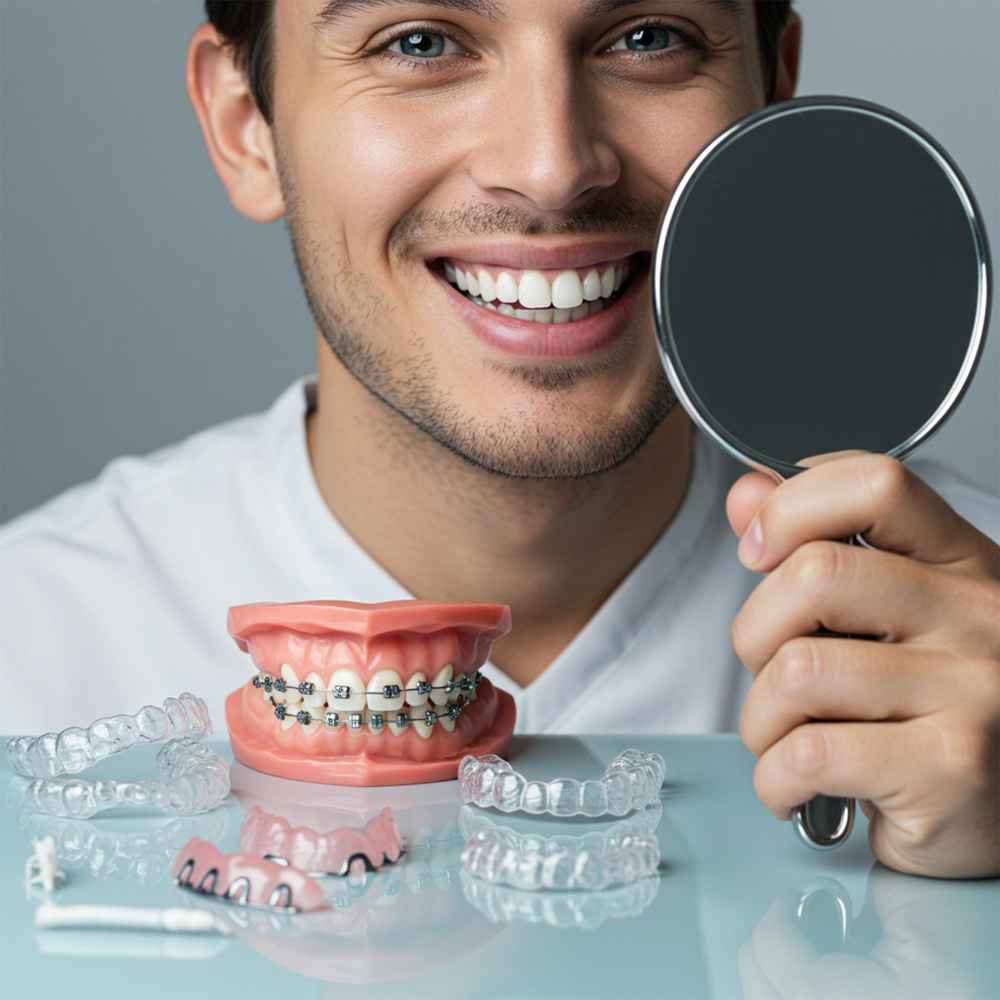
Dental braces are fixed orthodontic appliances consisting of brackets attached to the teeth and connected by wires. The appliance applies controlled forces to gradually move the teeth into their planned positions.
Because braces remain attached to the teeth during treatment, they continue working throughout the day without relying on the patient to insert or remove them.
Braces may be considered for:
- Moderate or severe crowding
- Significant tooth rotations
- Complex bite problems
- Large spaces between teeth
- Protruding teeth
- Teeth requiring precise movement
- Cases that may be less predictable with removable aligners
The type of brace recommended depends on the complexity of the case, treatment objectives, oral hygiene and cosmetic preferences.
Types of Braces
Traditional Metal Braces
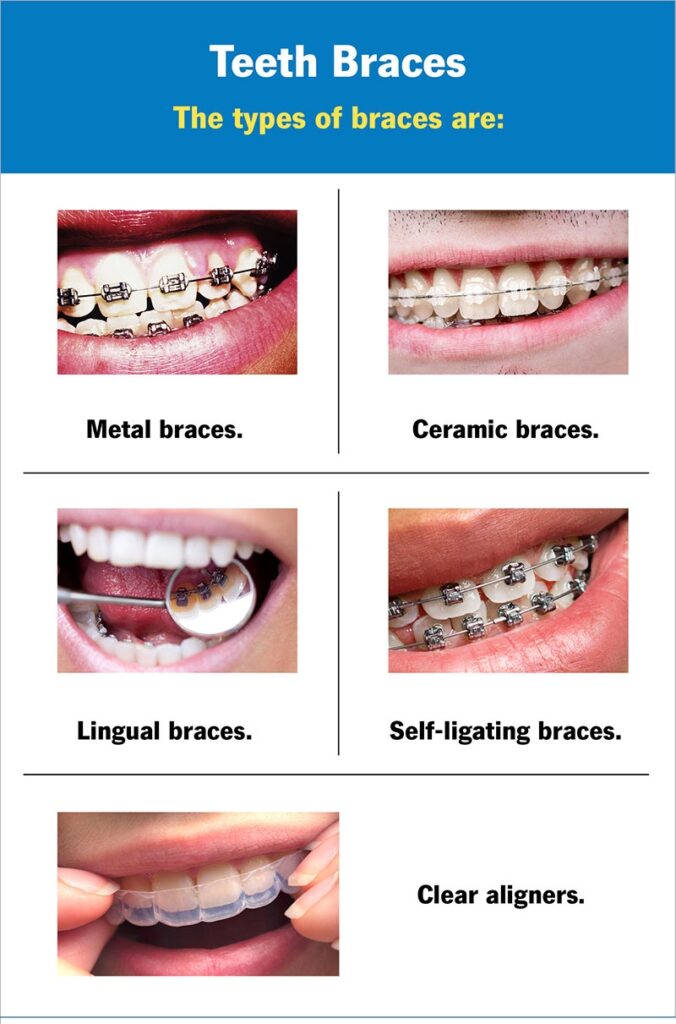
Metal braces use small metal brackets and orthodontic wires to move the teeth.
They are commonly selected because they can manage a wide range of tooth-alignment and bite problems. Small elastic modules may be used around the brackets and can sometimes be customised with different colours.
Metal braces may be suitable for children, teenagers and adults, depending on their dental condition.
Ceramic Braces
Ceramic braces work similarly to conventional fixed braces but use tooth-coloured or clear brackets that are less noticeable against the teeth.
They may be considered by patients who want a less visible fixed appliance. Ceramic brackets still require careful cleaning and regular adjustment appointments.
Their suitability depends on the tooth position, bite, lifestyle and treatment complexity.
Lingual Braces
Lingual braces are fixed to the inner surfaces of the teeth, making them less visible from the front. They are available for selected orthodontic cases but may not be appropriate for every patient.
Treatment planning for lingual braces depends on the bite, tooth shape, available space and complexity of the required tooth movements.
What Are Clear Aligners?
Clear aligners are a series of thin, customised, removable trays designed to fit over the teeth. Each aligner applies controlled pressure and is worn in a planned sequence to gradually move the teeth.
They are designed to be less noticeable than conventional braces and can be removed for eating, brushing and cleaning between the teeth.
Clear aligners may be suitable for:
- Mild to moderate crowding
- Small or moderate gaps
- Selected rotated teeth
- Mild bite irregularities
- Relapse following previous orthodontic treatment
- Adults and teenagers looking for a discreet treatment option
Clear aligners are not automatically suitable for every orthodontic problem. Severe bite irregularities, significant rotations, major spaces or complex jaw-related conditions may require braces, additional appliances or specialist treatment.
How Do Clear Aligners Work?
- Digital Assessment: Your teeth, gums and bite are examined. Photographs, dental X-rays, impressions or a digital scan may be required to record the current position of your teeth.
- Treatment Planning: The desired tooth movements are planned digitally. This allows the treating dentist or orthodontic professional to determine the sequence in which the teeth should move.
- Custom Aligner Fabrication: A series of clear trays is created according to the approved treatment plan.
- Wearing Each Aligner: Each aligner is worn according to the prescribed schedule before moving to the next tray. Successful treatment depends heavily on wearing the aligners consistently and following professional instructions.
- Progress Reviews: Regular appointments are required to monitor tooth movement, assess the fit of the aligners and make changes where necessary.
- Retainers: After active treatment, retainers are generally required to help maintain the corrected tooth positions. Teeth can move again when retention instructions are not followed.
Braces or Clear Aligners: Which Is Better?
Neither braces nor clear aligners are automatically the best option for every patient. The correct choice depends on the type and complexity of tooth movement required.
Braces May Be Recommended When:
- The crowding is significant
- Teeth are severely rotated
- Complex bite correction is required
- Precise or extensive tooth movement is necessary
- The patient may find consistent aligner wear difficult
- The case requires fixed appliance control
Clear Aligners May Be Considered When:
- The case is clinically suitable
- The patient prefers a discreet appliance
- The patient can follow the required wearing schedule
- Removability for eating and cleaning is important
- The required movements can be predictably achieved with aligners
Clear aligners require a high level of patient cooperation. Braces remain fixed, while removable aligners only work effectively when worn as instructed.
A detailed assessment is necessary before deciding which option is suitable.
Our Braces and Aligner Treatment Process
Orthodontic Consultation
Your concerns, treatment goals, dental history and expectations will be discussed.
2. Clinical Examination
Your teeth, gums, facial profile and bite will be evaluated. The examination may include checking for crowding, spacing, tooth rotations and jaw irregularities.
3. Diagnostic Records
Depending on the case, treatment planning may require:
- Dental photographs
- Digital scans or impressions
- Panoramic dental X-rays
- Cephalometric X-rays
- Bite records
- Additional investigations
4. Oral-Health Preparation
Cavities, gum inflammation and other active dental problems should be treated before braces or aligners are started. Good oral hygiene is essential because orthodontic appliances can make plaque control more challenging.
5. Treatment Recommendation
The available options will be explained, including:
- Type of appliance
- Estimated treatment stages
- Expected responsibilities
- Appointment schedule
- Possible limitations
- Retainer requirements
- Maintenance instructions
6. Appliance Placement or Aligner Delivery
Fixed braces are attached to the teeth, or the first set of clear aligners is provided with detailed wearing and cleaning instructions.
7. Regular Progress Appointments
Braces require periodic wire adjustments. Aligner treatment requires reviews to confirm that the teeth are moving according to the treatment plan.
8. Completion and Retention
After active tooth movement is completed, the braces are removed or aligner treatment is concluded. Retainers are then provided to maintain the new tooth positions.
Why Choose Virender Dental Care for Braces and Aligners?
- Detailed Orthodontic Assessment: Your teeth, gums, bite and jaw relationship are carefully evaluated before treatment is recommended.
- Braces and Clear Aligner Options: Suitable patients can discuss fixed braces, ceramic braces and clear-aligner treatment according to their clinical requirements and preferences.
- Personalised Treatment Planning: Every treatment plan is developed according to the patient’s tooth position, oral health, lifestyle and treatment goals.
- Comprehensive Dental Care: Cavities, gum problems, root canal requirements and other dental concerns can be identified and managed as part of your overall treatment plan.
- Focus on Function and Appearance: The objective is not only to create a straighter-looking smile but also to improve tooth positioning and bite function where clinically possible.
- Qualified Dental Guidance: Your consultation is conducted under the guidance of Mohit Jakhar Endodontist & Implantologist, BDS, MDS. Complex orthodontic conditions may be coordinated with or referred to an orthodontic specialist when necessary.
Frequently Asked Questions About Braces and Aligners
The better option depends on your tooth position, bite, treatment complexity and ability to follow instructions. Braces may be more appropriate for some complex movements, while aligners may be suitable for selected patients seeking a removable and less noticeable appliance.
Clear aligners are designed to be discreet, but they are not completely invisible. Attachments or elastics may also be required during treatment.
Yes. Adults may undergo orthodontic treatment when their teeth, gums and bone support are suitable. Existing dental or gum problems should be treated before active tooth movement begins.
Aligners must be worn according to the schedule provided by the treating professional. Removing them for long periods can interrupt tooth movement and delay treatment.
No. Fixed braces should only be adjusted or removed by a trained dental professional. Attempting to remove brackets at home can damage the enamel and gums.
Braces are designed to move teeth through controlled forces. However, poor oral hygiene during treatment can lead to decay, gum inflammation and enamel marks. Regular professional monitoring is essential.
Many patients do not require extractions. Removal is recommended only when the treatment assessment shows that additional space is necessary or a tooth has a poor prognosis.
Braces can treat many tooth and bite irregularities. Severe jaw-related problems may require additional appliances or combined orthodontic and surgical treatment.
Yes, but a properly fitted mouthguard may be recommended for contact or impact sports. A mouthguard helps protect the teeth, lips and orthodontic appliance from injury.
Teeth can move after treatment. Wearing retainers according to professional instructions is essential for maintaining the result.
Book a Braces or Clear Aligner Consultation in Hisar
Take the first step towards a straighter and more confident smile with a personalised orthodontic assessment at Virender Dental Care.
Clinic: Virender Dental Care
Head Dentist: Dr. Mohit Jakhar – Endodontist & Implantologist, BDS, MDS
Address: Opposite Fire Station, HTM Colony, Azad Nagar, Hisar, Haryana – 125001
Schedule your consultation to learn whether braces or clear aligners are suitable for your teeth and bite.
Orthodontic treatment suitability, duration and results vary according to tooth position, bite, gum health, jaw relationship and patient cooperation. A clinical examination and appropriate diagnostic records are required before treatment can be confirmed.