

Dental Crowns and Bridges in Hisar
Damaged, weakened or missing teeth can affect your ability to chew, speak and smile comfortably. Dental crowns and bridges are fixed restorations designed to strengthen compromised teeth, replace missing teeth and restore the appearance and function of your smile.
At Virender Dental Care, we provide personalised dental crown and bridge treatment in Hisar. Each restoration is planned according to your oral condition, bite, surrounding teeth and aesthetic preferences.
Your treatment is led by Dr. Mohit Jakhar – Endodontist & Implantologist (BDS, MDS). Following a detailed clinical examination and necessary dental imaging, you will receive a treatment plan suited to your individual needs.
What is a Dental Crown?
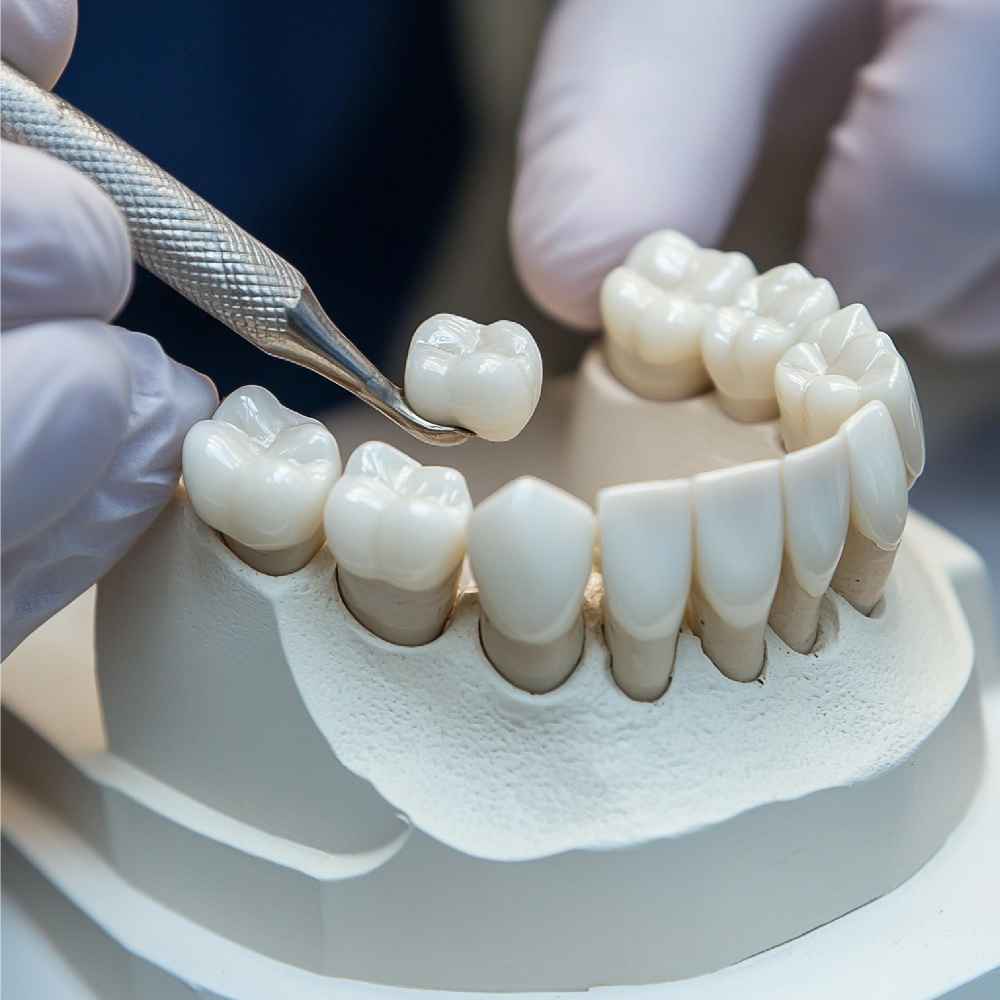
A dental crown is a customised restoration that covers the visible portion of a damaged or weakened tooth. It helps restore the tooth’s shape, strength, appearance and function.
A crown may be used to protect a weak tooth, restore a broken tooth or support a dental bridge.
Dental crowns may be recommended for:
- A severely decayed tooth
- A cracked or fractured tooth
- A tooth weakened by a large filling
- A tooth after root canal treatment
- A worn-down tooth
- A discoloured or irregularly shaped tooth
- A dental implant
- A tooth supporting a dental bridge
The type of crown recommended depends on the tooth’s location, remaining structure, bite forces and cosmetic requirements.
What Is a Dental Bridge?
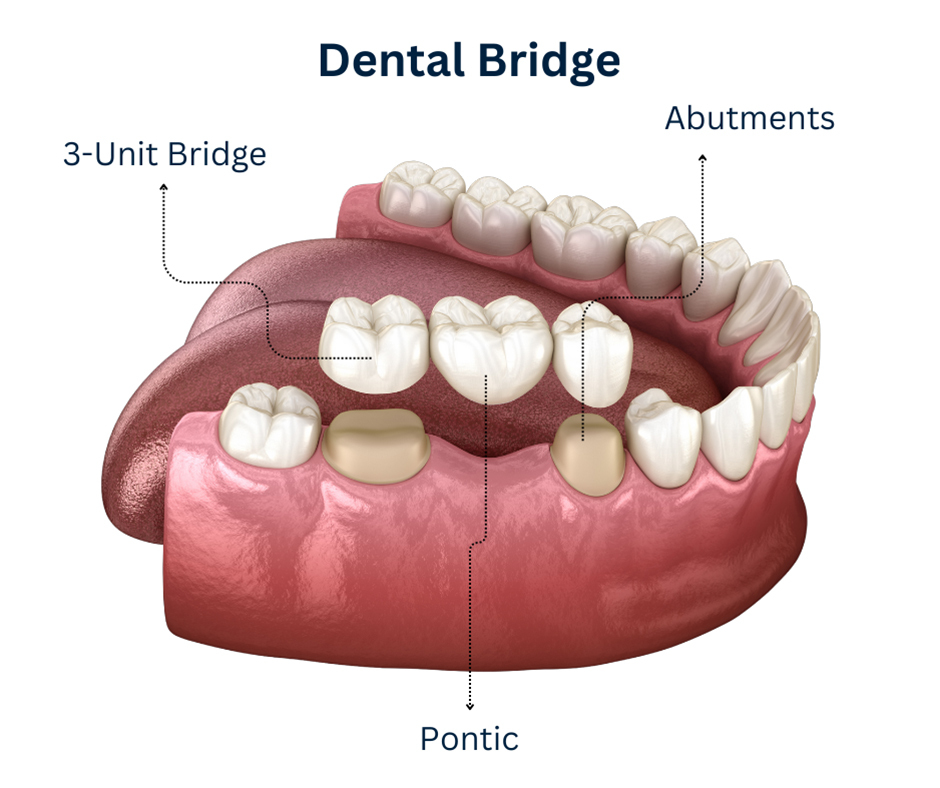
A dental bridge is a fixed restoration used to replace one or more missing teeth. It contains an artificial replacement tooth, known as a pontic, which is supported by neighbouring teeth, dental implants or a combination of suitable supporting structures.
A bridge fills the space left by missing teeth and may help restore chewing, speech and smile appearance.
Unlike a removable denture, a conventional bridge is fixed in place and is not removed by the patient for daily cleaning.
When is a Dental Crown Needed?
Your dentist may recommend a crown when a tooth cannot be restored predictably with a routine filling alone.
Common indications include:
- After Root Canal Treatment: A root canal-treated tooth may become more vulnerable to fracture, particularly when a large portion of the original tooth structure has been lost. A crown may be recommended to protect and restore the tooth. Not every root canal-treated tooth automatically requires the same restoration. The decision depends on the tooth’s location, remaining structure and bite.
- Severely Broken or Decayed Teeth: When damage extends beyond what can be reliably repaired with a filling, a crown can cover and reinforce the remaining tooth.
- Cracked or Weakened Teeth: A crown may hold weakened tooth structure together and reduce the risk of further fracture. The prognosis depends on the location and extent of the crack.
- Worn Teeth: Teeth affected by grinding, clenching or erosion may sometimes be restored with crowns as part of a carefully planned treatment. The underlying cause of wear must also be managed.
- Cosmetic Improvement: A crown may improve the colour, shape or proportion of a tooth when more conservative cosmetic treatments are unsuitable.
- Dental Implant Restoration: A crown can be attached to a dental implant to replace a single missing tooth.
When is a Dental Bridge Recommended?
A bridge may be considered when one or more teeth are missing and suitable support is available.
It may help:
- Restore the appearance of your smile
- Improve chewing efficiency
- Support clearer speech
- Prevent nearby teeth from moving into the gap
- Maintain a more balanced bite
- Restore the contour of the dental arch
- Provide a fixed alternative to a removable partial denture
Your dentist will assess the health of the supporting teeth, gums and bone before recommending a bridge.
Types of Dental Crowns
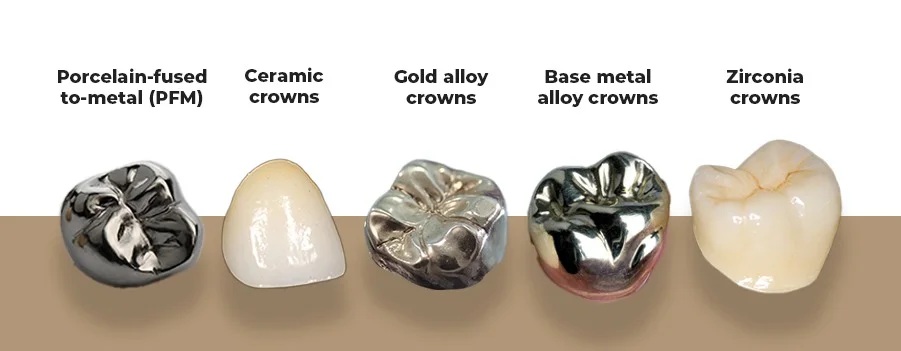
- Metal-Ceramic Crowns: Metal-ceramic crowns contain a strong metal substructure covered with tooth-coloured ceramic. They can provide a combination of strength and appearance and may be used for front or back teeth, depending on the clinical situation.
- All-Ceramic Crowns: All-ceramic crowns are made without a metal framework and are selected primarily for their tooth-coloured appearance. They may be considered for visible teeth where aesthetics are an important concern.
- Zirconia Crowns: Zirconia is a strong ceramic material used for a range of anterior and posterior restorations. The suitability of zirconia depends on the available tooth space, bite forces, restoration design and aesthetic requirements.
- Metal Crowns: Metal crowns may be used where strength and durability are priorities and appearance is less important. Because of their metallic colour, they are generally considered for less visible areas.
Types of Dental Bridges
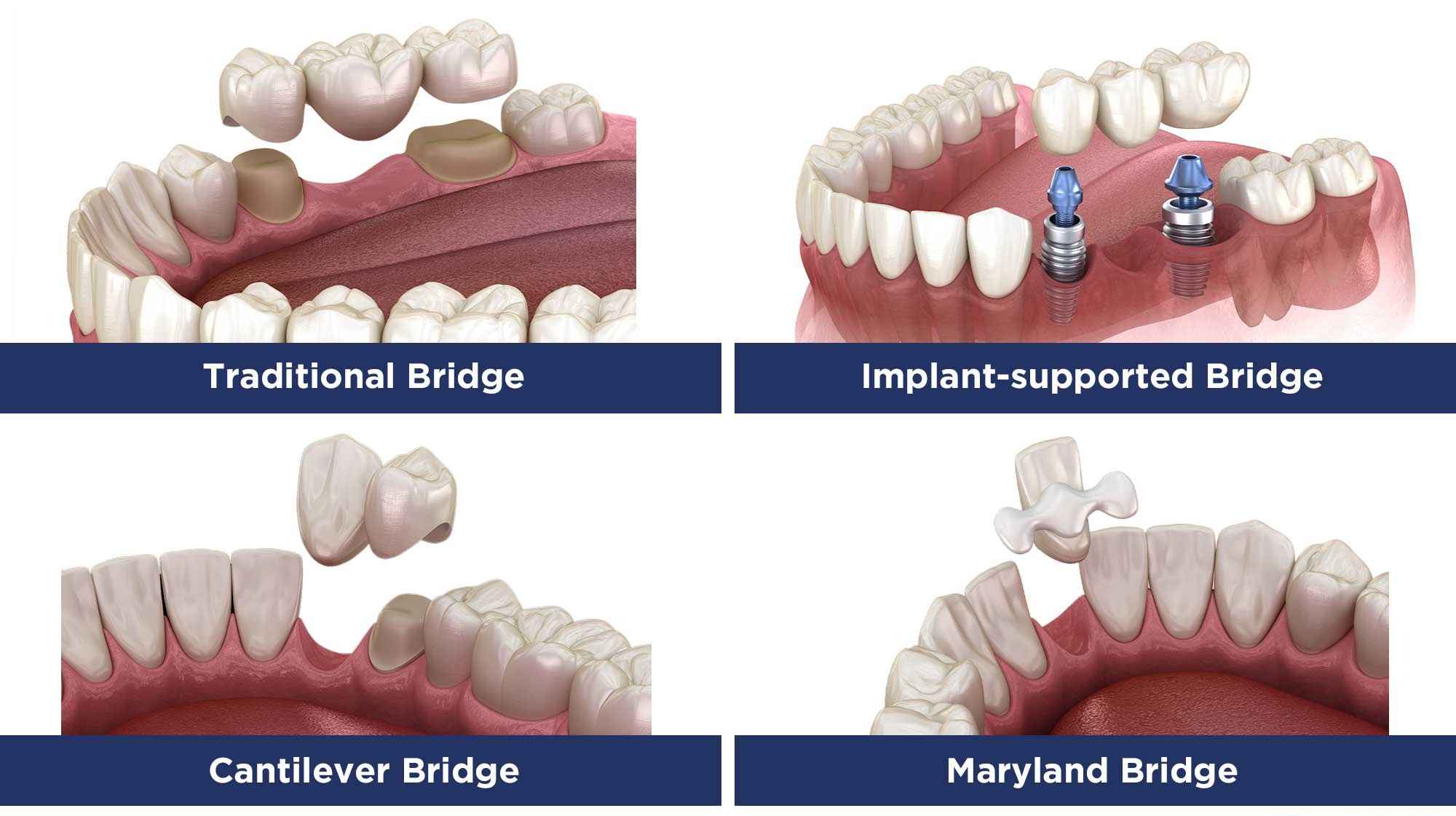
- Conventional Dental Bridge: A conventional bridge is supported by crowns placed over the teeth next to the missing-tooth space. The supporting teeth must be shaped to receive the crowns. The artificial tooth is connected to these crowns and fills the gap.
- Cantilever Bridge: A cantilever bridge is supported from one side of the missing-tooth space. It is used only in selected situations because the supporting tooth must withstand additional forces.
- Resin-Bonded Bridge: A resin-bonded bridge uses a metal or ceramic framework bonded to the back of one or more neighbouring teeth. It may require less removal of natural tooth structure than a conventional bridge, but it is not suitable for every location or bite.
- Implant-Supported Bridge: An implant-supported bridge is attached to dental implants rather than relying entirely on natural teeth. This option may be considered when multiple adjacent teeth are missing and the patient has adequate bone and healthy gums. A detailed implant assessment is required before treatment.
Benefits of Dental Crowns and Bridges
Depending on the procedure and oral condition, crowns and bridges may help:
- Restore damaged teeth
- Replace missing teeth
- Improve chewing ability
- Improve the appearance of the smile
- Strengthen weakened tooth structure
- Restore tooth shape and height
- Support a balanced bite
- Protect selected root canal-treated teeth
- Prevent neighbouring teeth from shifting
- Provide a fixed tooth-replacement option
Treatment results vary according to the condition of the teeth, gums, bone and bite.
Our Crown and Bridge Treatment Process
1. Consultation and Dental Examination
Your dentist will examine the affected tooth, surrounding gums, adjacent teeth and bite.
Dental X-rays may be advised to evaluate:
- Tooth roots
- Bone support
- Existing decay
- Previous root canal treatment
- Infection
- Supporting teeth
- Missing-tooth spaces
2. Treatment Planning
Your dentist will explain whether a crown, bridge, dental implant, filling or another treatment would be suitable.
The proposed material, appearance, treatment stages, limitations and maintenance requirements will also be discussed.
3. Tooth Preparation
For a conventional crown or bridge, the supporting tooth or teeth are carefully shaped to create sufficient space for the restoration.
Local anaesthesia may be used to keep the area comfortable.
4. Impression or Digital Measurement
An impression or digital scan is recorded to capture the shape of the prepared teeth, surrounding teeth and bite.
These records are used to create a customised restoration.
5. Temporary Restoration
A temporary crown or bridge may be placed while the final restoration is being prepared.
Temporary restorations should be handled carefully because they are not as strong as the final crown or bridge.
6. Final Fitting
At the fitting appointment, the crown or bridge is checked for:
- Fit
- Bite
- Shape
- Contact with neighbouring teeth
- Gum relationship
- Colour and appearance
Necessary adjustments are made before the restoration is fixed in place.
7. Review and Maintenance
A follow-up visit may be recommended to evaluate comfort, bite and gum health.
Why Choose Virender Dental Care?
- Personalised Treatment Planning: Every crown and bridge is planned according to your tooth condition, bite, surrounding teeth and treatment goals.
- Focus on Natural Appearance: The colour, shape and proportions of the restoration are selected to blend with your smile wherever clinically possible.
- Restorative and Implant Expertise: Your treatment is planned by an endodontist and implantologist, allowing crown and bridge care to be coordinated with root canal and implant treatment when required.
- Attention to Function and Fit: The restoration is evaluated for bite, contact, stability and comfort before final placement.
- Clear Maintenance Guidance: You will receive practical instructions for cleaning and protecting your crown or bridge.
- Qualified Dental Care: Your consultation and treatment are provided under the guidance of Dr. Mohit Jakhar Endodontist & Implantologist, BDS, MDS
Frequently Asked Questions
A crown is commonly recommended for root canal-treated teeth that have lost significant structure or are exposed to heavy chewing forces. The final decision depends on the tooth’s condition and location.
A conventional dental bridge is fixed in place and cannot be removed by the patient. It must be cleaned carefully around and underneath.
Tooth-coloured crowns can be customised for shade, shape and size. The final appearance depends on the material selected, underlying tooth colour, gum position and clinical conditions.
A conventional crown or bridge commonly requires more than one visit. The exact number depends on the treatment method, condition of the teeth and whether additional procedures are required.
The crown itself does not develop decay, but the natural tooth underneath can decay near its margins. Daily brushing, interdental cleaning and regular examinations remain essential.
After the final restoration has been fitted and any temporary sensitivity has settled, most patients can return to normal eating. Very hard or sticky foods should be approached carefully.
Neither treatment is automatically better for every patient. A bridge may be suitable when adjacent teeth require crowns, while an implant can replace a missing tooth without relying on neighbouring teeth. Bone, gum health, treatment time and other factors must be evaluated.
Book a Crown and Bridge Consultation in Hisar
Restore damaged or missing teeth with a customised crown or bridge at Virender Dental Care.
Clinic: Virender Dental Care
Head Dentist: Dr. Mohit Jakhar – Endodontist & Implantologist, BDS, MDS
Address: Opposite Fire Station, HTM Colony, Azad Nagar, Hisar, Haryana – 125001
Schedule a consultation for a detailed examination and personalised treatment recommendation.
Treatment suitability, durability and results vary according to the condition of the teeth, gums, supporting bone and bite. A clinical examination and appropriate diagnostic imaging are required before treatment is confirmed.