Book your appointment online and secure your dental slot easily. Book Now
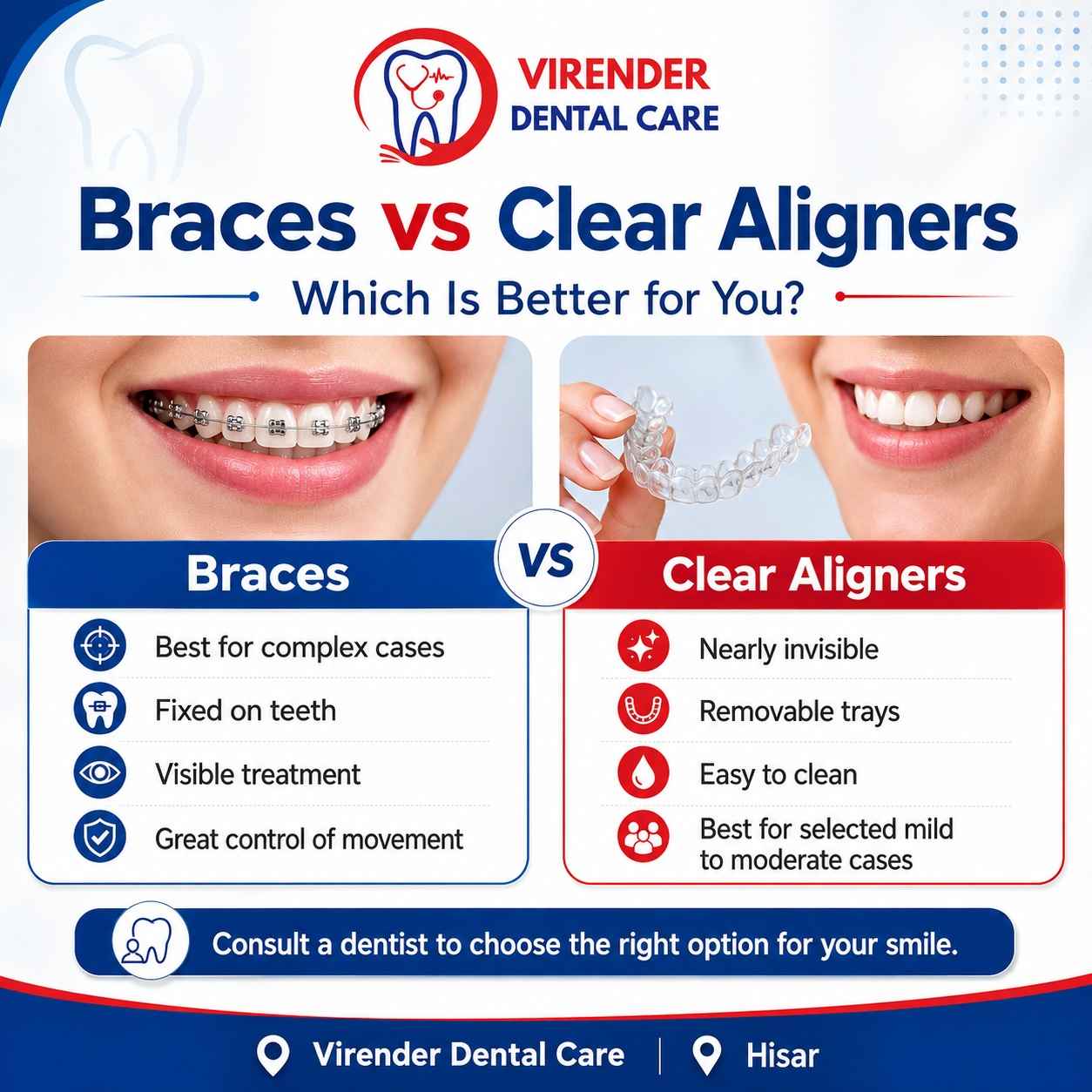
Crooked, crowded or unevenly spaced teeth can affect your smile, bite and ability to clean certain areas properly. Braces and clear aligners are two commonly used orthodontic treatments that gradually move teeth into improved positions.
Both options can deliver effective results, but neither is automatically better for every patient. The right treatment depends on the complexity of your tooth alignment, bite, oral health, lifestyle and ability to follow treatment instructions.
At Virender Dental Care in Hisar, your teeth, gums and bite are assessed before a suitable teeth-straightening option is recommended.
Traditional braces use brackets fixed to the teeth and connected by orthodontic wires. These components apply controlled pressure that gradually moves the teeth into their planned positions.
Braces may be used to manage:
Because braces remain attached to the teeth throughout treatment, they do not depend on the patient remembering to wear them. They can treat a broad range of orthodontic problems, including cases that may be less predictable with removable aligners.
Clear aligners are customised, transparent trays that fit over the teeth. A sequence of trays is used, with each aligner applying controlled pressure to move selected teeth gradually.
Aligners are removable and less noticeable than traditional metal braces. They generally need to be worn for approximately 20 to 22 hours a day, or according to the treating professional’s instructions.
Clear aligners may be suitable for selected cases involving:
Aligners are not suitable for every patient. Some complex tooth movements and bite problems can be managed more predictably with fixed braces or a combination of orthodontic techniques.
| Factor | Braces | Clear aligners |
|---|---|---|
| Appearance | Visible brackets and wires | Transparent and less noticeable |
| Removability | Fixed to the teeth | Removable |
| Daily cooperation | Work continuously | Must be worn as instructed |
| Eating | Some hard and sticky foods must be avoided | Removed before meals |
| Cleaning | Requires careful cleaning around brackets | Teeth are easier to brush normally |
| Complex cases | Suitable for a wide range of problems | Suitability depends on the case |
| Discomfort | Tenderness may occur after adjustments | Pressure may occur with each new tray |
| Risk of loss | Cannot be misplaced | Trays may be lost or damaged |
Both treatments can cause temporary pressure or tenderness because the teeth are being moved.
Braces may cause discomfort after fitting or adjustment, and brackets can temporarily irritate the lips or cheeks. Clear aligners are smooth and removable, but a new tray may feel tight during the first few days.
Comfort varies between patients, so it should not be the only factor used to choose treatment.
Clear aligners can be removed for brushing and cleaning between the teeth. However, the teeth should be clean before the trays are reinserted, and the aligners must also be cleaned regularly.
Braces require more detailed brushing around brackets and wires. Interdental brushes or other cleaning aids may be recommended to remove plaque from difficult areas.
Poor cleaning with either appliance can increase the risk of gum inflammation, tooth decay and white marks on the enamel. Aligners can also trap food or sugary liquids against the teeth when inserted without proper cleaning.
With fixed braces, hard, sticky and chewy foods can damage brackets or wires. Foods such as ice, hard sweets, chewing gum and popcorn may need to be avoided.
Clear aligners are removed before eating, allowing patients to continue eating most foods. However, the trays must be stored safely, and the teeth should be cleaned before the aligners are placed back in the mouth.
Clear aligners are not automatically faster. Treatment time depends on:
Aligner treatment can take as long as braces in some cases, and failure to wear the trays as prescribed can delay progress.
Braces may be recommended when:
Metal braces may also be practical for younger patients who may struggle with the responsibility of wearing and storing aligners.
Clear aligners may be considered when:
Attachments or elastics may still be required, so clear-aligner treatment is not always completely invisible.
Yes. Teeth can move again after braces or aligner treatment. Retainers help stabilise the corrected tooth positions and should be worn according to the instructions provided by the treating professional.
Stopping retainer wear can allow the teeth to shift, even after successful treatment.
The decision between braces and clear aligners should be based on a professional examination rather than appearance alone.
Your assessment may include:
Existing cavities, gum disease and other active oral-health problems should be treated before orthodontic treatment begins.
Aligners can effectively treat many alignment and bite problems, but some complex movements may be managed more predictably with braces.
Yes. Adults can undergo orthodontic treatment when their teeth, gums and supporting bone are healthy enough for tooth movement.
Aligners can be removed temporarily, but frequent or prolonged removal may delay treatment. They should be worn for the recommended daily duration.
Cost depends on the appliance, treatment complexity, expected duration and additional procedures. An accurate estimate requires an orthodontic assessment.
Get a personalized assessment to determine whether braces or clear aligners are more suitable for your teeth, bite and lifestyle.
Virender Dental Care
Opposite Fire Station, HTM Colony
Azad Nagar, Hisar, Haryana – 125001
Appointment: +91 72064 25552